How Biodegradable Starter Cups are Revolutionizing Kampala’s Transplant Survival Rates
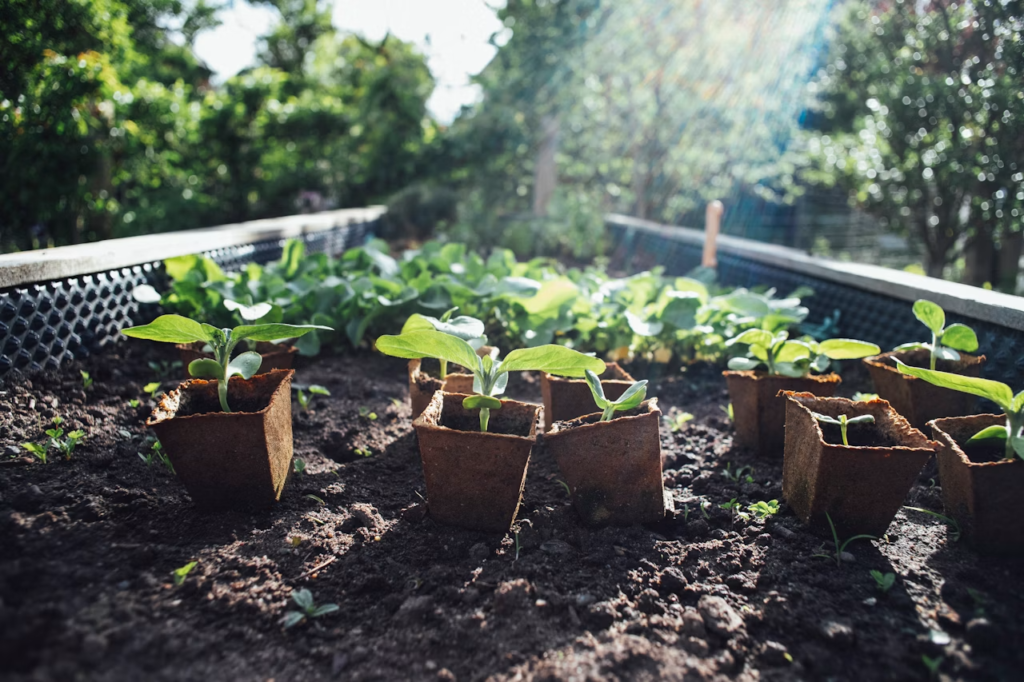
There is a quiet, golden moment in every urban farmer’s morning when the sun hits the backyard patch, illuminating the vibrant green of new life pushing through rich, dark earth.
As captured in our featured visual Header.jpg, the early stages of a plant’s life are its most critical. In the past, urban backyards across Kampala, Mukono, and Wakiso struggled with high seedling mortality rates. Delicate spinach, pepper, and tomato sprouts would wither within days of being moved from plastic nursery sleeves into home garden beds.
To solve this, the Fresh Yard Initiative—supported by S4P Group and Home Harvest—is shifting the paradigm. By combining premium, compost-rich raised beds with biodegradable fiber starter pots, we are helping families achieve unprecedented growth from day one.
1. Banishing “Transplant Shock” with Fiber Cups
The traditional method of transplanting involves peeling away thin black plastic nursery bags, which often tears the fine, hair-like roots of the seedling. This structural damage triggers “transplant shock,” causing the plant to droop, lose its leaves, or die.
The solution, visible in Header.jpg, is elegant and entirely organic. We nurse our seeds in biodegradable pots made of compressed wood fibers and peat.
- Zero Root Disturbance: When the seedling is ready, the entire pot is placed directly into the soil of the raised bed.
- Rapid Root Expansion: The breathable fiber walls allow roots to easily penetrate outward as they grow, rather than getting bound and coiled.
- Natural Degradation: Over a period of several weeks, soil microbes break down the pot completely, turning it into rich organic matter that nourishes the surrounding earth.
2. Setting the Perfect Foundation: Rich Raised Soil
Even the best seedling will struggle without the right foundation. As seen in the dark, aerated soil structure in Header.jpg, our agronomists construct raised beds filled with a custom, nutrient-dense growing medium.
Standard backyard dirt in Kampala is often heavily compacted or nutrient-depleted clay. We build raised timber or masonry frames to a height of at least $30\text{ cm}$ and pack them with a scientific mix:$$\text{Soil Mix} = 50\% \text{ Forest Soil} + 30\% \text{ Mature Kitchen Compost} + 20\% \text{ Decayed Coir/River Sand}$$
This specific ratio ensures optimal drainage so that heavy tropical downpours do not suffocate the roots, while retaining just enough moisture to keep the soil biologically active during dry afternoons.
3. The Quantified Outcome
Transitioning urban compounds to this “biodegradable cup + raised bed” model has unlocked impressive agricultural and ecological yields:
- Near-Perfect Survival Rates: Seedling survival rates have jumped from a baseline of $72\%$ using plastic sleeve transplants to an outstanding $96\%$ survival rate using fiber cups.
- Faster Harvest Turnaround: Because plants experience zero transplant shock, they establish roots instantly and reach maturity up to $2\text{ weeks}$ faster than traditional bare-root transplants.
- Plastic Waste Eradication: This initiative has successfully prevented over $5,000$ single-use plastic nursery sleeves from entering Kampala’s municipal waste stream and local drainage channels.
“I used to buy ten tomato seedlings and watch five of them die during transplanting. With the fiber cups Fresh Yard brought, every single one took root. Our raised bed is so dense now, we are sharing excess harvests with our neighbors.”
— Nsubuga Ronald, Bukoto Resident